

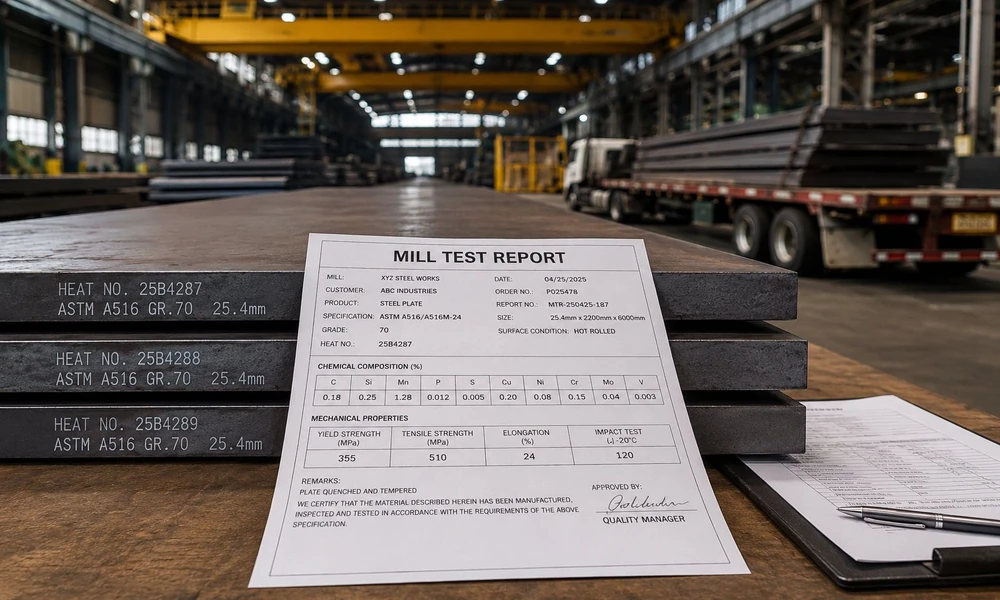
The certificate that ships with your steel has the original melt number printed on it, and that one line settles most disputes before they start.
Most order disputes I’ve watched between a shop and a fabricator trace back to a spec sheet nobody read closely enough. You approved a quote, the material got cut, and only later did someone notice the thickness tolerance was wrong or the grade didn’t match. The paperwork was sitting in an email the whole time.
A mill test report, usually called an MTR or mill cert, is the paper trail that proves what got delivered. It travels with the steel from the mill through every hand that touches it, including the metal supplier in Austin TX that cuts and delivers your material. Learning to scan one takes about five minutes and saves weeks of rework. Here’s how I read them, in the order I actually check things.
What a Mill Test Report Actually Certifies
An MTR is a declaration from the mill that a specific heat of steel meets a specific standard. A heat is one batch melted in one furnace, so every plate, beam, or tube poured from that heat shares the same chemistry. The report lists the heat number, the grade, the mechanical properties (yield, tensile, elongation), the chemical composition, and often the heat treatment applied.
What it does not certify is anything the mill didn’t test. If a sheet was welded after it left the plant, the MTR says nothing about that weld. This trips people up constantly. The cert covers the mill’s product, not your finished assembly.
One thing worth knowing: standards for material test reports are maintained by bodies like NIST, and published standards spell out what documentation a supplier owes a buyer. That framework is why a legitimate cert has recognizable fields in a recognizable order rather than a homemade invoice with a grade scribbled on it.
Check the Heat Number First, Always
Start at the top. The heat number on the paper must match the heat number stamped or tagged on the material you received. If it doesn’t match, stop. Pull the shipment tag, photograph it, and call your supplier before a single piece goes on the saw.
A heat mismatch isn’t automatically fraud. It usually means a mixed load, a mistyped pick ticket, or a partial shipment from a different heat. But you can’t verify chemistry against the wrong document, so resolve it first. I’d rather hold a delivery for a day than cut forty brackets from steel I can’t trace.
Two practical questions worth asking your supplier when you call: can you send the certs for every heat in the load, and can you consolidate them into one packet with each heat number highlighted? A supplier who stocks material and delivers direct usually has this ready. One that has to hunt through a filing cabinet tells you something about their admin.
Do the Grade and Chemistry Match Your Drawing?
Once the heat number checks out, compare the grade on the MTR to the grade on your drawing or spec. A36, A992, 6061-T6 aluminum, and Corten all behave differently, and “mild steel” on a purchase order hides more than it reveals. Name the grade explicitly when you order, and check that the cert repeats the same name back.
Then read the chemistry columns. You don’t need to memorize limits. You need the carbon and manganese values to sit inside the range the standard allows for that grade, and you need to notice when a figure is marked as a maximum rather than an actual test result. Those are different things.
Structural steel grade requirements trace back to standards work maintained by the American Institute of Steel Construction, which publishes the design guidance your engineer is likely referencing. If your drawing cites a specific ASTM or AISC designation, the cert should carry the same one. When it doesn’t, ask before you cut.
The Mechanical Properties and Test Direction
Yield strength, tensile strength, and elongation are the three numbers most fabricators glance at and most buyers misinterpret. A yield value tells you when the steel starts to deform permanently. Tensile tells you when it fails. Elongation tells you how much it stretches first. All three come from a physical test of a specimen cut from that heat.
Here’s where people get caught: test direction matters. Steel rolled in one direction behaves differently when tested along the rolling direction versus across it. The report should say which way the specimen was oriented. If your application puts the material under stress across the grain, a cert with only longitudinal results gives you partial information.
A Quick Approval Checklist
Before you sign off on a fabrication order, run this short list. It takes less time than finding a parking spot downtown.
- Heat number on the cert matches the tag on the material.
- Grade on the cert matches the grade named on your drawing or purchase order.
- Thickness and dimensions on the cert match what was delivered, tolerance included.
- Chemistry values fall inside the range for that grade.
- Yield, tensile, and elongation are present, with test direction noted.
- Any heat treatment or coating is described and matches what you ordered.
- You have a cert for every heat in the load, not just the first one.
Print the checklist and tape it above the saw. Paper on a wall beats a note buried in a shared drive, and I’d wager most shops already have something similar for cuts and tolerances. Certs deserve the same treatment.
Keep Copies the Way You Keep Records
Store certs by job number, not by supplier and not by date. Three years from now, when someone asks whether the guardrail on a job used the specified steel, you want to reach for one folder and find one document. Suppliers reorganize, staff leave, and email accounts get archived. Your copy is the one that survives.
If record retention rules apply to the work you do, the National Archives publishes general guidance on how long business records are typically held, though your contract and your industry will set tighter terms. Storage costs nothing. Replacing steel on a completed job costs plenty.
The Cost of Skipping the Read
Skipping the cert review never feels risky in the moment, because nothing has gone wrong yet. Then a client’s engineer asks for traceability on a job that’s already up, and a week gets spent reconstructing paperwork instead of building. I’ve seen that scramble. It’s the least fun part of this trade.
Five minutes on the front end buys you a clean answer on the back end. Read the cert before the steel hits the saw, not after the order ships. If your supplier can’t produce a matching certificate on request, that’s your answer about whether they belong in your next quote cycle. What does your current checklist actually catch, and what slipped through last year?
